Career · AI Engineering
AI-First Developers: Why Hiring for This Profile Is Exploding
September 2026 · 8 min read
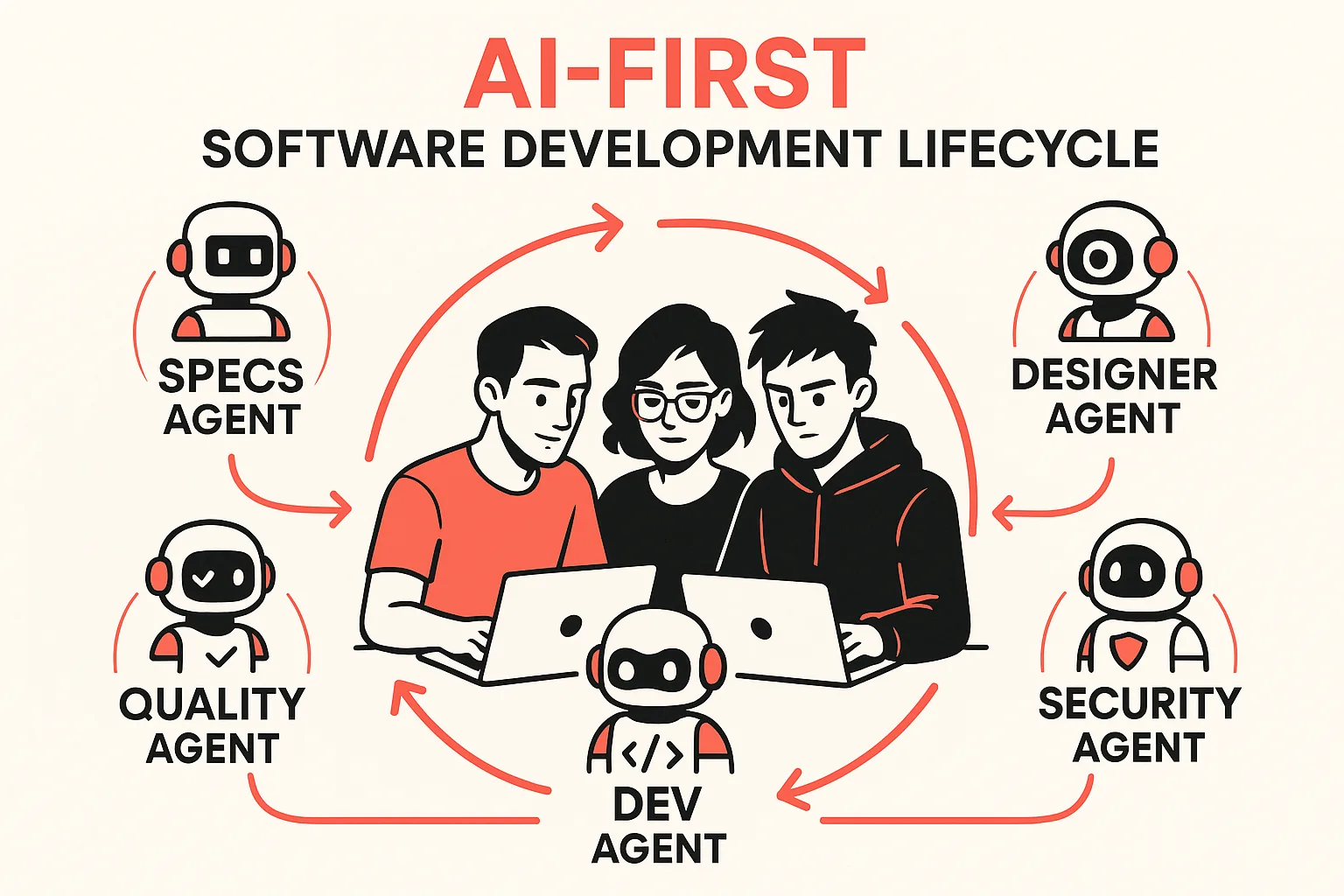
Hiring posts increasingly ask for something that did not exist as a job title five years ago: an AI-first developer. Not “someone who tried ChatGPT once,” but an engineer who designs delivery around models, agents, evaluation, and human review — the same way a senior frontend designs around performance budgets and accessibility.
What “AI-first” actually means in hiring
In serious teams, AI-first is a workflow claim, not a buzzword on a CV. Recruiters and hiring managers are looking for people who can:
- Ship features faster by pairing IDE agents with strong engineering judgment
- Build product surfaces that call LLMs safely (prompts, tools, RAG, guardrails)
- Measure quality: eval sets, regression checks, cost/latency budgets
- Own failure modes — hallucinations, prompt injection, data leakage — like any other production risk
That is why job ads shifted from “familiarity with AI tools” to “builds with AI as a default multiplier.”
Why hiring for this profile is exploding
- Productivity pressure — companies want smaller teams shipping the same roadmap.
- Product differentiation — copilots, assistants, and automated ops are now table stakes in SaaS.
- Tooling maturity — Cursor, Claude, Copilot, and agent SDKs made the workflow teachable and interviewable.
- Competitive signaling — “AI-native engineering culture” is used to attract talent and reassure investors.
AI-first developer vs traditional senior engineer
The fundamentals did not disappear. Type systems, architecture, testing, and security still decide whether AI output is usable. The difference is the default path:
- Traditional default: design → hand-write → review → ship
- AI-first default: specify → generate/assist → critically review → harden → ship
Seniors who cannot review AI output carefully become liability amplifiers. Juniors who only paste answers without systems thinking stall in code review. The hires winning offers combine both: speed and taste.
What strong candidates demonstrate
- A portfolio that shows AI used for real delivery (refactors, tests, docs, feature slices) — not only chat screenshots
- Clear boundaries: secrets, licenses, and “do not generate this” policies
- Product sense for AI UX: streaming, citations, fallbacks, and human override
- Ability to say no when a model is the wrong tool
How teams should hire (and how candidates should prepare)
For hiring managers: stop asking “Do you use ChatGPT?” Ask candidates to debug a broken agent flow, improve an eval, or turn a vague PRD into a safe implementation plan with tools and tests.
For developers: treat AI literacy like TypeScript literacy — daily practice, public artifacts, and opinions backed by shipped work. Learn prompting, but also learn retrieval, observability, and when to fall back to deterministic code.
The uncomfortable truth
Demand is rising faster than shared standards. Some companies label every role “AI-first” while their stack is still a CRUD app with a chatbot widget. The durable career move is deeper: become the engineer who can integrate intelligence into reliable software, not the person who only chases model names.
AI-first hiring is real. The winners will be builders who use models as leverage — and still take responsibility for every line that reaches production.