Frontend Architecture · Micro-Frontends
Monolith vs. Micro-Frontends: How to Choose the Right Frontend Architecture in 2026
October 2026 · 9 min read
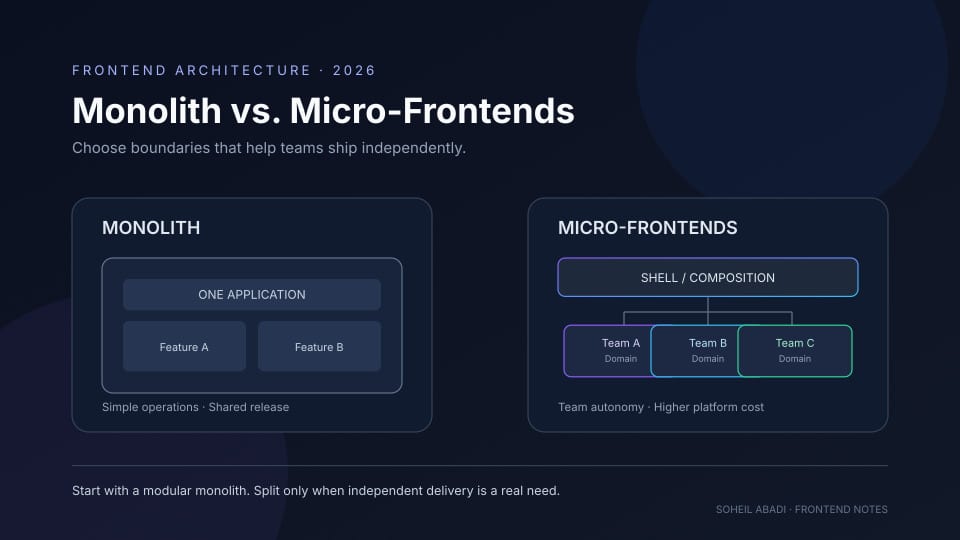
Frontend architecture discussions often turn into a choice between “one big app” and “micro-frontends.” That framing misses the real question: which boundaries help your team deliver product changes safely and independently without creating more operational work than they remove?
A monolithic frontend is not automatically messy, and micro-frontends are not automatically scalable. Both can be well-designed—or painful. The right choice depends on team structure, release independence, domain boundaries, performance budgets, and the cost of operating the system.
What is a monolithic frontend?
In a monolithic frontend, the user interface is usually built, tested, and deployed as one application. Features share a routing system, design system, dependency graph, and release process. A React or Next.js application with clearly separated feature modules can still be a monolith.
Where a monolith works well
One team, or a small number of closely collaborating teams, owns the product.
Features frequently share UI, state, navigation, and domain workflows.
You want straightforward local development, testing, deployment, and debugging.
Consistent performance and a unified user experience matter more than independent releases.
Common failure modes
The problem is rarely “monolith” by itself. Trouble starts when modules have unclear ownership, dependencies flow in every direction, shared state becomes global by default, or every small change requires coordinating a large number of people. Build times and regression risk can grow as boundaries deteriorate.
What are micro-frontends?
Micro-frontends split a frontend into independently owned parts that can be developed—and, when the architecture supports it, deployed—separately. Teams may integrate those parts through route-level composition, a shell application, web components, iframes, or runtime module loading. These approaches are not interchangeable: each has different isolation, UX, performance, and deployment characteristics.
When micro-frontends can help
Several teams own distinct business domains and need meaningful release autonomy.
Different areas have different release cadences or legacy constraints.
Team coordination and deployment coupling are measurable bottlenecks.
The organization can invest in platform tooling, observability, integration contracts, and shared UX standards.
The costs teams often underestimate
Runtime and performance: duplicated dependencies, extra requests, and slower navigation if composition is poorly designed.
Consistency: design-system drift, inconsistent accessibility, and different loading or error states.
Integration: routing, authentication, analytics, shared navigation, and cross-domain workflows need explicit contracts.
Operations: more pipelines, versioning decisions, monitoring, and failure scenarios.
Testing: local tests are not enough; integration and end-to-end coverage must validate the assembled product.
Independent deployment is a capability, not a free side effect. If every release still requires synchronized changes across all frontend teams, you may have added distributed-system complexity without gaining real autonomy.
Consider the modular monolith first
A modular monolith keeps one deployable application while enforcing strong internal boundaries. For many products, it is the best middle ground: easier to operate than a distributed frontend, but much easier to evolve than a tightly coupled codebase.
In React or Next.js, you can organize by business domain rather than technical file type:
src/
  app/                 # routing and composition
  features/
    billing/
      components/
      api/
      model/
      tests/
    claims/
      components/
      api/
      model/
      tests/
  shared/
    ui/
    lib/
    types/
Keep domain-specific code inside its feature. Make cross-feature imports intentional. Put genuinely shared components in a design-system layer, not in a generic “shared” folder simply because two files happen to look alike. Define API contracts at boundaries and avoid letting every feature mutate another feature’s internal state.
A practical decision checklist
Choose a monolith when one team can coordinate changes and the product benefits from shared workflows.
Choose a modular monolith when the codebase is growing but independent deployment is not yet a proven requirement.
Evaluate micro-frontends when separate teams need real autonomy across stable domain boundaries—and you can fund the platform overhead.
Before splitting, answer these questions with evidence:
How often do teams block one another’s releases?
Which domains have clear ownership and few shared workflows?
Can each proposed frontend be tested and released without coordinating a global change?
What are the budgets for JavaScript, network requests, startup time, and navigation?
Who owns shared authentication, navigation, design tokens, telemetry, and accessibility?
What is the rollback and degraded-mode plan if one frontend fails?
If you decide to adopt micro-frontends
Start with one low-risk, clearly bounded domain—not a big-bang rewrite. Define ownership, integration contracts, versioning rules, shared design-system policy, observability, and rollback before moving production traffic. Measure outcomes such as lead time, deployment independence, incident rate, page performance, and team coordination—not the number of independently deployed bundles.
What about monorepos?
A monorepo is a repository strategy, not a frontend architecture. You can keep a monolithic application or multiple micro-frontends in one repository. Tools such as workspace package managers and task runners can improve dependency management and build caching, but they do not create good domain boundaries by themselves.
The takeaway
Start with the simplest architecture that supports your current team boundaries. Build a modular monolith with clear ownership and dependency rules. Move toward micro-frontends only when independent delivery is a real organizational need and the expected benefit outweighs the runtime and operational cost. Architecture should remove bottlenecks—not merely move them from code into infrastructure.